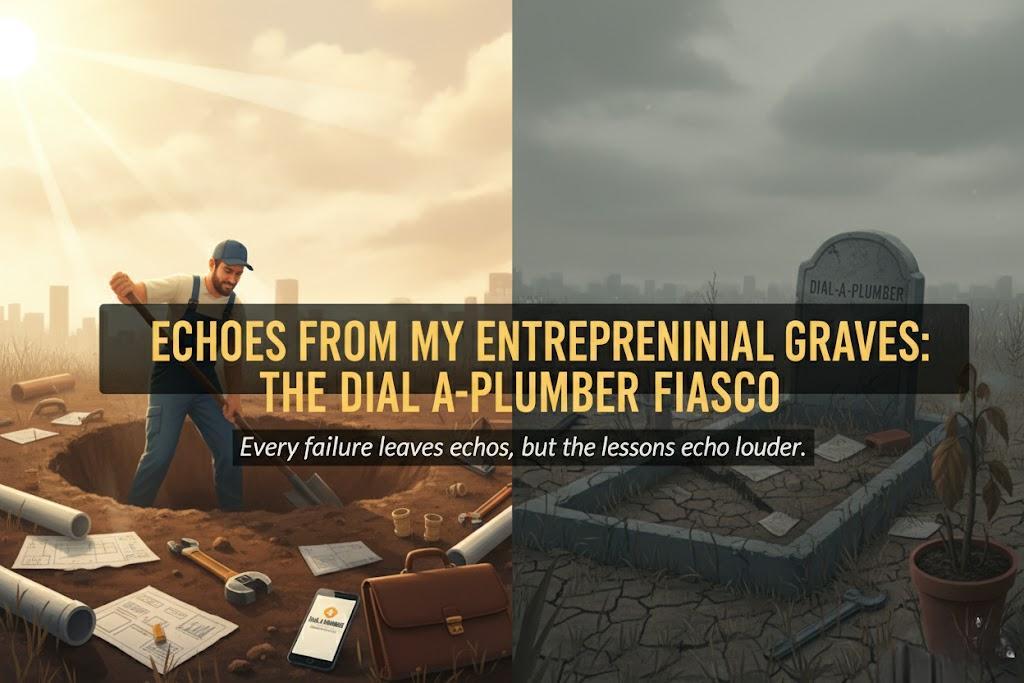
CONFESSIONS OF BUSINESS LAZARUS #11: Echoes From My Entrepreneurial Graves:The Dial-A-Plumber Fiasco
Introduction
Every entrepreneur has a story that didn’t end with success — one that left behind valuable lessons, scars, and wisdom. For me, that story begins with a company called Dial-A-Plumber Limited — my first major entrepreneurial attempt and my first real failure. Looking back, I call this chapter “Echoes from my Entrepreneurial Grave.”
It was the late 1980s, and alongside my lifelong friend, Kayode Ayeni, we decided to dive into the deep waters of business with youthful passion and blind optimism. We believed we could change the world — or at least revolutionize the plumbing industry in Nigeria.
The Birth of an Ambitious Idea
The idea for Dial-A-Plumber is a little blurry now, but it likely came from Kayode, who was always the more inventive and daring one between us. I was louder and more expressive, so people often credited me as the risk-taker. In truth, it was his creativity that sparked many of our ventures.
Together, we jumped headfirst into the idea, investing our time, energy, and limited savings into building something entirely new. Our concept was simple but revolutionary for Nigeria in 1990:
Instead of hunting for a local handyman whenever a plumbing issue arose, customers could simply call a dedicated number, and a professional plumber — uniformed, well-equipped, and reliable — would show up to fix the problem.
We envisioned a modern, organized plumbing service that would transform how people accessed home repair solutions. Sounds familiar, right? In essence, we were trying to build what has now become today’s “service-on-demand” industry — just about three decades too early.
When Vision Outran Reality
In our excitement, we missed one crucial detail — the market wasn’t ready.
Nigeria in 1990 wasn’t equipped for that kind of modern business model. Infrastructure was weak, technology was limited, and consumers weren’t accustomed to structured service systems. But in our youthful idealism, we saw ourselves as pioneers destined to change everything.
We dreamed of scaling beyond plumbing — into mechanics, carpentry, and other personal service industries. We even imagined franchises and nationwide coverage. Unfortunately, reality soon humbled us.
Despite early excitement and some initial customer interest, Dial-A-Plumber crumbled under the weight of its challenges. We underestimated costs, overestimated demand, and lacked the business experience and capital to sustain operations.
The Dial-A-Plumber Syndrome
Years later, I coined a term for the mistakes we made: “The Dial-A-Plumber Syndrome.”
It describes the common entrepreneurial trap of trying to innovate beyond one’s capacity and environment — of creating something visionary before the market, the economy, or your own resources are ready for it.
We wanted to be trailblazers, but what we really needed to be was learners. Dial-A-Plumber wasn’t just a failed business; it was a priceless classroom.
The Lessons Buried in the Failure
Here’s what that failure taught me — lessons I carry to this day:
- Innovation is powerful, but timing is everything.
A great idea executed too early can fail just as badly as a bad one. - Passion without preparation leads to frustration.
Enthusiasm is important, but understanding your market and having a plan is essential. - Not all good ideas are good businesses.
Vision must meet viability. - Failure is not final.
The ruins of Dial-A-Plumber became the foundation of every success I’ve had since.
Looking Back — and Forward
Today, more than 30 years later, the service-on-demand industry we once dreamed of is a multi-billion-dollar global market. Startups now thrive doing what we once struggled to explain to potential investors.
In hindsight, Dial-A-Plumber wasn’t a failure — it was a prototype for the future. We were simply ahead of our time.
Every entrepreneur has their own version of this story — a “Dial-A-Plumber” moment where ambition outpaces ability. But those moments aren’t the end; they are the training grounds for greatness.
Final Thoughts
Failure doesn’t mean you were wrong to try. It just means the lesson wasn’t in the winning — it was in the doing.
If you’re standing in the ashes of your own failed venture, listen closely — there are echoes of wisdom in that graveyard. Those echoes are what prepare you for the next breakthrough.
As for me, the Dial-A-Plumber Fiasco remains one of my most valuable entrepreneurial teachers. It taught me that every failure is simply a future success — waiting for better timing, better preparation, and a wiser version of you.
Key Takeaway
“Being ahead of your time is just another way of saying you were unprepared for your opportunity.”